Glossary
A working vocabulary for modern marketing intelligence. Each entry includes a definition, an example, and a worked calculation where relevant.
A

B
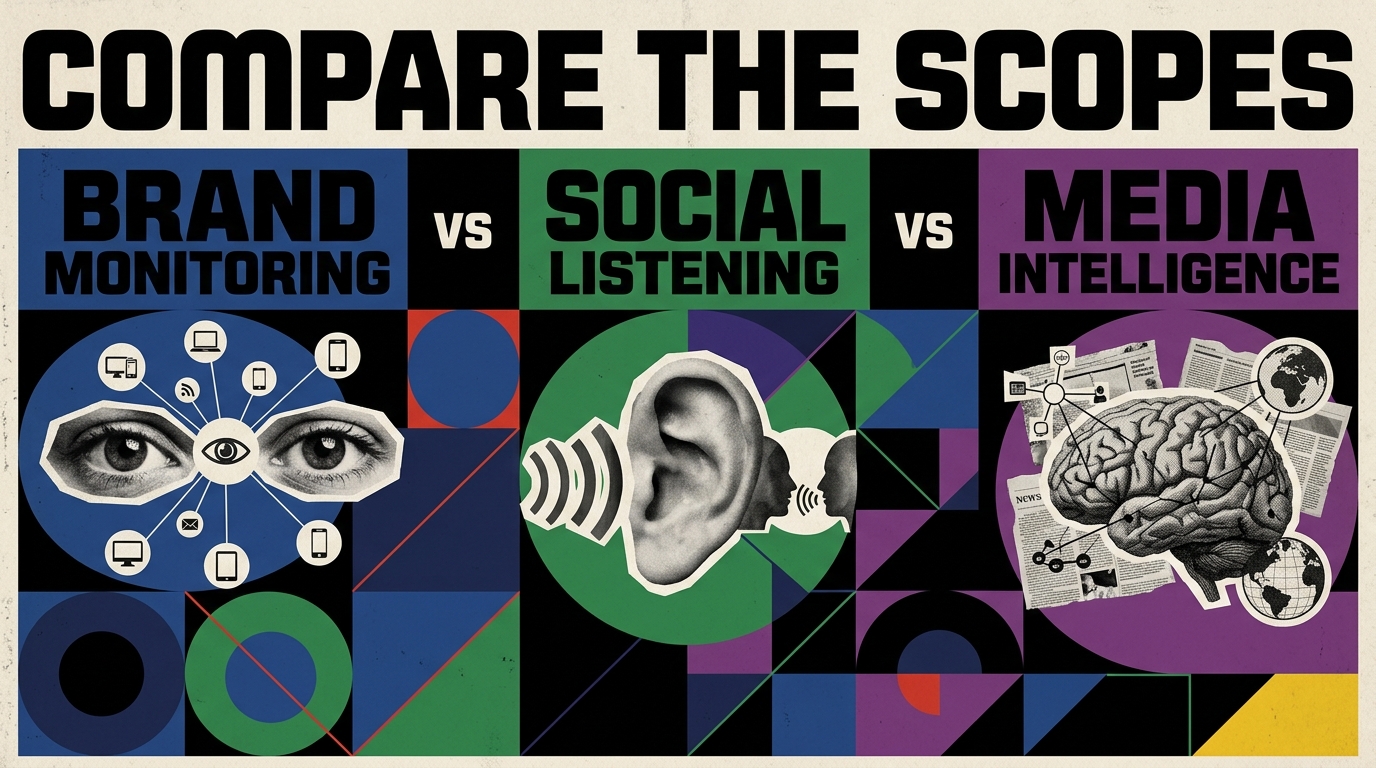
Brand monitoring vs social listening vs media intelligence
Brand monitoring tracks named-entity mentions of one brand across digital surfaces. Social listening adds topic and conversation tracking on top, capturing discussions that never name the brand. Media intelligence adds traditional press, TV, and ecommerce reviews. The three are nested, not synonyms · social listening is a superset of brand monitoring, and media intelligence is a superset of social listening. Sentia spans all three in one workspace, which is why teams in 2026 stop paying for two separate tools.
Read more

Brand Impact Score
A Brand Impact Score is a composite metric fusing reach, engagement, sentiment, and authority. Learn how cohort calibration reveals true marketing performance.
Read more
C

CPM, CPC, CPE · and which one to actually care about
CPM is cost per thousand impressions, CPC is cost per click, and CPE is cost per engagement. CPE is the most defensible of the three for blending paid and organic performance because engagement is the one signal both surfaces produce in comparable units. In 2026, marketing teams that report blended CPE alongside calibrated EMV get cleaner conversations with finance than teams that defend CPM in isolation, because CPE survives the question "what did this actually do".
Read more

Creator affinity
Creator affinity is a creator's organic mention history with a brand or its competitive set, separated from any paid relationship. A creator who tagged a brand 14 times across IG and TikTok in 2026 without ever being paid scores higher affinity than one who posted twice as part of a contracted partnership. The metric matters because creators with prior organic affinity convert from outreach at roughly 2 to 3 times the rate of cold creators sourced by lookalike modelling.
Read more

Calibration
Calibration grades a marketing metric against a peer distribution rather than an absolute scale, showing whether performance is top quartile, median, or weak.
Read more

CVS · Creator Value Score
The Creator Value Score (CVS) is Sentia's per-creator score, fusing reach, engagement, brand affinity, and partnership cost into one geography-aware number. The Italy-aware variant adjusts for the Italian creator market's tighter follower-to-engagement ratio and lower CPM bands. CVS matters because raw follower-count creator lists confuse popularity with effectiveness; a 200k-follower creator with 8% engagement and prior brand affinity often outperforms a 2M-follower creator with no affinity.
Read more

Cohort benchmarking
Cohort benchmarking compares a brand with structurally similar peers using standardized metrics, percentile bands, and regularly refreshed cohorts.
Read more

CPS · Campaign Performance Score
The Campaign Performance Score (CPS) ranks Sentia's AI-clustered campaigns by composite reach, engagement, creative variance, and cross-channel coverage. It replaces ranking-by-cluster-size with ranking-by-impact, surfacing the campaign that moved the brand even when it shipped fewer posts. CPS matters in 2026 because campaign clustering naturally produces fat-tail noise; the score separates the campaign that worked from the campaign that just generated volume.
Read more

CIS · Calibrated Impact Score
The Calibrated Impact Score (CIS) is Sentia's competitor-leaderboard score, fusing reach, engagement, sentiment, and growth into one number calibrated against the brand's cohort. It powers the headline ranking on the Sentia competitor view and replaced share-of-voice as the default sort in 2026. The score matters because raw competitor leaderboards reward whoever spends the most; a calibrated score rewards whoever moves the most relative to peers.
Read more
E

EMV (Earned Media Value)
Earned Media Value (EMV) is a dollar estimate of what organic social mentions, press coverage, and creator posts would have cost if purchased as paid media. Sentia computes EMV per post in 2026 using a category-specific CPM benchmark, never a single global rate. The metric lets marketing teams place earned reach on the same axis as paid spend without conflating the two.
Read more

Engagement rate
Engagement rate is the share of a brand's audience that interacted with a post, calculated as (likes + comments + shares + saves) divided by followers or impressions, then expressed as a percentage. The unqualified number is meaningless because a 9% rate on 800 followers and a 0.4% rate on 8 million followers describe completely different brands. Sentia recomputes engagement rate manually in 2026 because the value stored on Instagram posts is unreliable.
Read more
F

M

O

P

PAS · Paid Amplification Score
The Paid Amplification Score (PAS) classifies a brand's paid-ad pattern into one of four shapes: always-on, test-and-scale, burst, and minimal. The pattern matters because the same total spend produces wildly different outcomes depending on cadence; a burst pattern signals product launches while always-on signals brand-building. Sentia computes PAS from observed ad-run lengths and spend distributions in 2026 and renders it on every competitor detail page so analysts can read the strategy in one glance.
Read more

PPS · Paid Performance Score
The Paid Performance Score (PPS) is Sentia's per-post score, weighting reactions, comments, shares, and video views against a 90-day account average to surface the post that broke the brand's pattern. Per-platform weights differ: TikTok weights views, Instagram weights comments, YouTube weights watch time. PPS matters in 2026 because it answers the only useful per-post question, which is whether this post out-performed the brand's own baseline, not whether it beat an arbitrary global benchmark.
Read more
S

Sentiment analysis
Sentiment analysis is the automated classification of a piece of text as positive, negative, or neutral toward a named entity. In 2026, modern systems use a single LLM pass instead of the lexicon-and-regex stacks that dominated until 2022, lifting accuracy on sarcasm and contextual statements from roughly 70% to the high 80s. The number matters because every downstream alert, share-of-voice cut, and crisis trigger inherits its error rate from the sentiment layer beneath it.
Read more

Share of voice
Share of voice measures a brand's percentage of mentions, impressions, or other attention within a defined competitive set and period.
Read more