The TikTok Static Anomaly: Why Image Ads Command 95x More Median Spend Than Video
We analyzed 10,000 TikTok ads to find a massive format anomaly. While brands flood the platform with video, static image ads command 95 times more median spend.
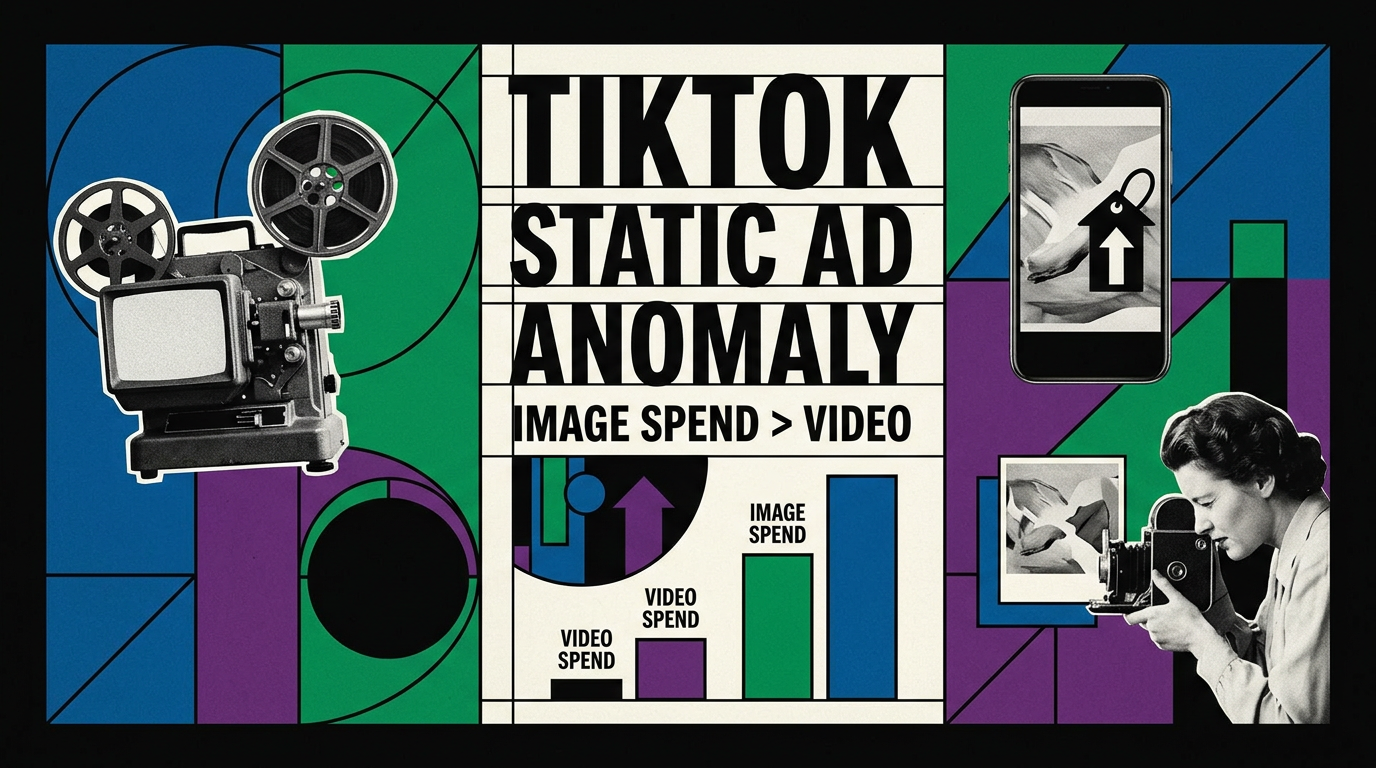
TikTok is universally understood as a short-form video platform. Marketers construct entire content operations around the premise that motion, sound, and rapid pacing are the absolute prerequisites for capturing attention and clearing the algorithm. But when you look past the conventional wisdom and analyze how ad budgets actually behave in the wild, a completely different reality emerges.
We recently analyzed a cohort of 10,000 TikTok ads deployed by five Italian brands over the last 90 days [1]. This dataset represents over 341,000 Euros in total platform spend [2]. We wanted to understand exactly what types of creative assets are successfully consuming budget.
What we found is a massive structural anomaly in format delivery. While video remains the dominant format by sheer volume of uploads, it is static images that are quietly commanding the lion's share of median ad spend.
The High-Churn Video Graveyard
Most operators know that TikTok requires creative volume. The accepted playbook is to flood the platform with video variations, letting the algorithm pick the winners.
Our cohort data perfectly illustrates this shotgun approach. Out of the 10,000 ads analyzed, 7,579 were video creatives [3].
However, the vast majority of these videos are dying almost instantly. The median spend for a video ad in this cohort is a microscopic 0.19 Euros [4]. Let that sink in. Brands are paying for creators, editors, and motion graphics, only to have the platform's delivery algorithm shut off the faucet before the ad even spends a single Euro.
This is the algorithmic meat grinder in action. TikTok will briefly test a video, find its engagement metrics lacking, and brutally restrict its reach. The result is a graveyard of thousands of micro-spend videos that technically went live but functionally did nothing.
The Static Image Anomaly
If video ads are choking at 19 cents, where is the money actually going?
The answer lies in a format most video-first marketers ignore: the humble image ad.
The cohort produced 1,749 image ads [5]. Unlike their video counterparts, these static assets are successfully clearing the algorithm's delivery thresholds. The median spend for an image ad sits at 18.14 Euros [6].
When we compare the two formats, the disparity is staggering:
| Format | Total Ads Uploaded | Median Spend |
|---|---|---|
| Video | 7,579 | €0.19 |
| Image | 1,749 | €18.14 |
This is the signal your dashboard is likely missing. By obsessing over video, operators are throwing thousands of assets into a high-rejection environment. Meanwhile, image ads (often deployed as carousels) are retaining user attention long enough to satisfy TikTok's pacing requirements, allowing them to act as stable, dependable workhorses for campaign delivery.
CPM Parity: The Missing Variable
The immediate assumption when seeing a 95x multiplier in median spend is that inventory costs must be drastically different. Perhaps images are simply more expensive to serve, artificially inflating their spend numbers?
The data explicitly disproves this.
With identical CPMs, the budget disparity is entirely a function of ad delivery. The algorithm is willfully choosing to serve static images to a broader audience over a longer timeframe. At 38 cents per thousand impressions, an image ad spending 18.14 Euros is successfully reaching roughly 47,000 screens. A video ad spending 19 cents is dying after just 500 impressions.
Strategic Takeaways for Operators
This data forces a recalibration of how media buyers should approach TikTok architecture.
First, stop treating TikTok strictly as a television substitute. The platform functions just as effectively as a visual catalog. Users are highly willing to swipe through static image carousels, and the algorithm rewards this engagement with sustained ad delivery.
Second, use images to anchor your campaigns. If you know that video creatives face a 90 percent chance of dying before spending a single Euro, you cannot rely on them for baseline volume. Static ads can provide the foundational spend and daily reach required to keep your ad account seasoned while you continue to test highly volatile video assets.
Finally, audit your production costs. If you are spending 80 percent of your creative budget on video production, but static images are the assets actually capable of spending your media dollars, your resource allocation is inverted. Shift a portion of your studio time toward high-fidelity photography and bold typography. The algorithm is telling us exactly what it wants to serve; it is time for operators to listen.
Keep Reading
Start with one monitor. Free.
Add a brand, paste a couple of competitor handles, and see your first calibrated readout in under five minutes.