The 1.60-Euro Video Ad: Why 14 Brands Are Sharding Engagement Across 2,548 Accounts
We analyze a 120-day cohort of 4,787 engagement ads to reveal how 14 brands are hacking CPMs by sharding their budgets across 2,548 local ad accounts.
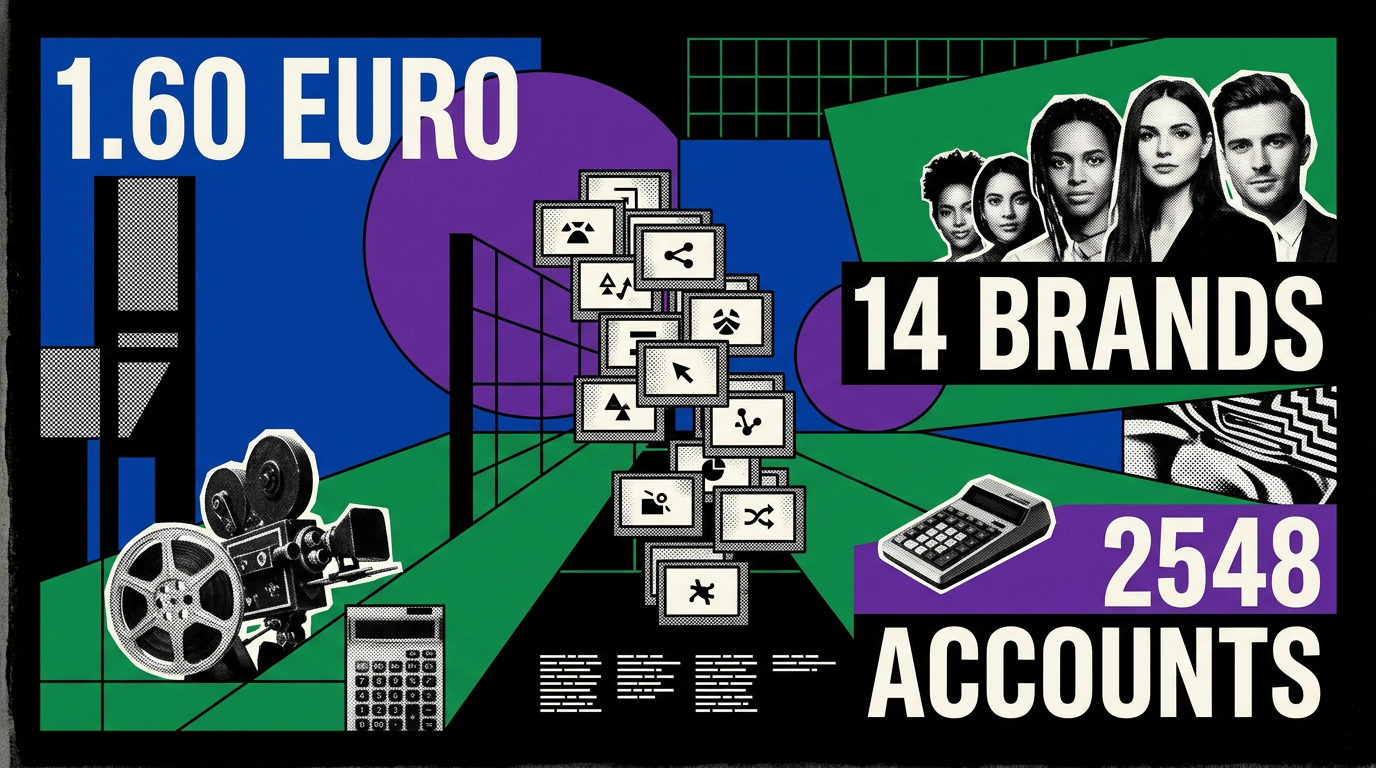
The loudest advice in performance marketing right now is to consolidate. Ad network representatives constantly tell operators to combine their ad sets, limit their active creatives, and funnel budget into broad targeting to exit the algorithmic learning phase. The theory is that machine learning needs massive data density to find the right users. However, a recent analysis of engagement campaigns in the Italian market reveals a hidden layer of advertisers doing the exact opposite. They are entirely ignoring the learning phase.
The Sharded Architecture
We examined a 120-day cohort of 4,787 engagement ads targeting Italy. What immediately stands out is not the volume of creatives, but the architecture delivering them. These thousands of ads belong to just 14 brands.
If these operators were following the standard consolidation playbook, we might expect to see a few dozen ad accounts at most. Instead, these 14 brands are routing their campaigns through an astonishing 2,548 distinct ad accounts. That represents an average of 182 separate ad accounts dedicated to a single brand.
This extreme decentralization completely fractures campaign budgets. Across the entire analysis window, the total spend for this cohort was 79,386.27 Euros. When you spread that capital across thousands of localized or hyper-segmented ad accounts, the unit economics become microscopic. The median spend for an ad in this cohort is just 23.78 Euros.
The Format Arbitrage
Why would an enterprise brand deploy such tiny budgets per ad? The answer lies in the pursuit of ultra-cheap inventory. Across the total cohort, the median CPM sits at a surprisingly low 0.30 Euros. But when we split the data by creative format, a massive arbitrage opportunity emerges between static and video assets.
| Format | Ad Volume | Median Spend | Median CPM |
|---|---|---|---|
| Unknown / Static | 4,440 | 23.78 EUR | 3.19 EUR |
| Video | 339 | 1.60 EUR | 0.30 EUR |
The table above highlights a deliberate, high-volume trading strategy. The bulk of the campaign volume relies on standard formats, which carry a median CPM of 3.19 Euros and a median spend of 23.78 Euros.
But look at the video tier. These brands deployed 339 video ads with a median CPM of just 0.30 Euros. Even more shocking is the budget constraint: the median spend for a video ad is capped at an incredibly low 1.60 Euros.
Decoding the 1.60-Euro Video Ad
Let us unpack the mechanics of a 1.60-Euro video ad. In a traditional centralized campaign setup, spending less than two Euros on a video creative is considered a failure. It usually means the ad network tested the creative, found zero resonance with the audience, and abruptly halted delivery to protect the user experience.
But in a sharded architecture spanning thousands of ad accounts, this is not a failure. It is a feature.
At a 30-cent CPM, a budget of 1.60 Euros buys roughly 5,300 impressions. The median total reach for ads in this cohort is 617 users. This paints a very clear picture of the strategy at play. These are not national brand-awareness campaigns. They are hyper-local engagements.
This structure is typically the fingerprint of large franchise networks, regional dealership models, or real estate brokerages. Rather than running one national engagement campaign from a central headquarters account, the brand uses automated software to deploy bespoke ads from the individual ad accounts of their local franchisees. Each local branch only needs to reach the few hundred people who live within walking distance of their storefront.
The Takeaway for Operators
By forcing the delivery through local ad accounts, brands bypass the national auction competition entirely. They tap into local inventory pools where video CPMs drop to absolute floor pricing. The central brand provides the video template, the automation software swaps in the local address, and the local ad account pushes it to a few hundred nearby residents for less than the cost of a cup of coffee.
For marketing operators relying on a single massive ad account, this data serves as a stark warning. Consolidating your budget might feed the algorithm, but it also forces you to pay national-average CPMs. The brands in this cohort have realized that engagement is incredibly cheap on the fringes. By building the infrastructure to manage over two thousand accounts, they have unlocked a tier of video inventory that costs pennies on the dollar. They are proving that sometimes, the most effective way to scale your reach is to think incredibly small.
Keep Reading
Start with one monitor. Free.
Add a brand, paste a couple of competitor handles, and see your first calibrated readout in under five minutes.