The Ghost Reach Epidemic: Why 28,000 Instagram Views Yield Just 6 Interactions
We analyzed 6,863 Instagram posts from Italian brands to uncover a massive disconnect: while median views hit 27,000, interactions flatline at just six. Here is how operators need to pivot.
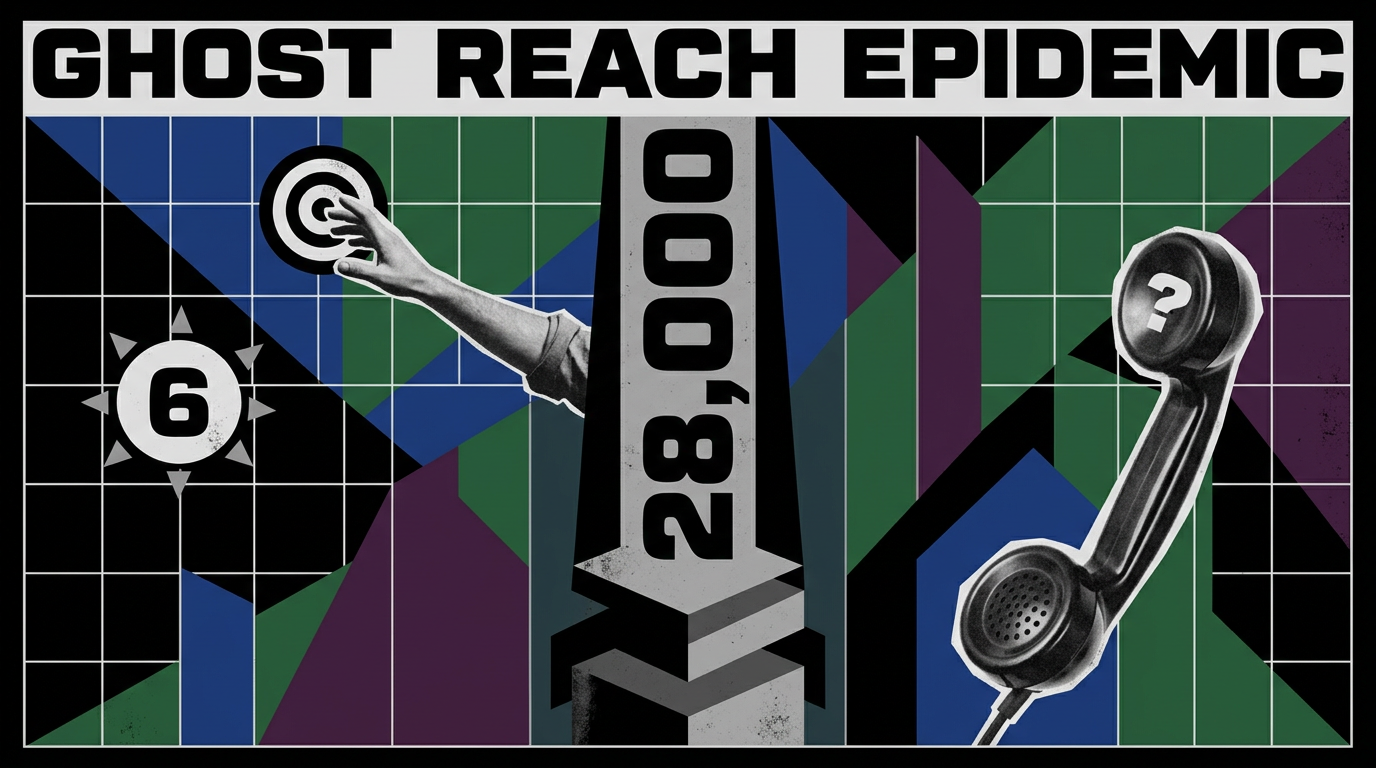
The era of the interactive Instagram community is effectively over for organic brand accounts. If you need proof, you only have to look at the widening chasm between how many people see a brand post and how many people actually interact with it.
Social media managers are currently sitting in marketing meetings reporting massive view counts. The dashboards look green. But when you look closely at the interaction metrics, the reality is stark. Audiences are treating brand content like television commercials. They will let it play on their screen, but they refuse to acknowledge its existence.
To understand just how passive the feed has become, we isolated a 90-day window from early March to early June of 2026. We looked at a cohort of twenty-six brands operating in the Italian market on Instagram.
The sheer volume of content these brands produce suggests a strategy built around staying top of mind. Across this three-month window, these brands published 6,863 posts. The median brand in this cohort published 138 times. That is roughly one and a half posts every single day. They are feeding the algorithmic machine with relentless consistency.
At first glance, the machine is rewarding them.
The Hollow Victory of Reach
If your sole metric for success is eyeballs, the current Instagram algorithm is delivering. The median views per post in this cohort sits at 27,993.
Think about that number for a moment. Every time the median brand hits publish, nearly 28,000 users have that content pass across their screens. If you break into the upper tier of performance, the numbers scale beautifully. The 75th percentile of posts achieves 66,150 views.
For operators who cut their teeth in the early days of organic social media, these reach numbers look like a massive win. You are getting tens of thousands of impressions without paying for a sponsored ad placement.
But reach without resonance is just noise. The true story of this cohort is found in the interaction columns.
Six Interactions
Out of the 27,993 users who view the median post, almost none of them care enough to leave a like, a comment, or a share.
The median interactions per post for this entire 6,863-post cohort is exactly six.
Let that sink in. You publish a piece of content. The algorithm pushes it to 28,000 screens. And six people interact with it. The disconnect between consumption and action is absolute.
Even if we look at the highest performing content in the cohort, the picture does not improve significantly. The 75th percentile of posts brings in 66,150 views, but only manages to generate 23 interactions. On the other end of the spectrum, the bottom 25 percent of posts earn a median of just two interactions.
The Death of the One Percent Benchmark
For years, social media operators used a one percent engagement rate as the absolute floor for acceptable performance. If a post fell below one percent, it was considered a failure. Three percent was good, five percent was viral.
In the Italian market today, a one percent engagement rate is a ceiling most brands never touch.
The median engagement rate for this cohort is an abysmal 0.59 percent. The top 25 percent of posts, the absolute best performers in this 6,800-post sample, top out at an engagement rate of 0.90 percent. Meanwhile, the bottom quartile drags along at 0.38 percent.
This incredibly tight clustering tells us something vital. The low engagement is not a result of bad creative from a few lazy brands. When the 75th percentile cannot even crack a one percent engagement rate, you are looking at a systemic platform reality. The format has changed. The user behavior has changed.
What This Means for Operators
If you are an operator reading these signals, you need to adjust your strategy and your internal reporting immediately.
Stop optimizing for interactions. If your creative team is spending hours agonizing over calls to action, trying to bait users into commenting or tagging a friend, they are wasting their time. The audience is not going to comment. They are in a passive scroll state. Treat your organic Instagram feed like a digital billboard. You have three seconds to make brand impact before the user scrolls past. Design for instant visual recognition, not deep engagement.
Reset executive expectations. You cannot allow your leadership team to judge organic social performance on engagement rates anymore. If they are asking why the engagement rate is below one percent, show them this cohort data. Explain that a 0.59 percent engagement rate is not a failing grade, it is the exact middle of the bell curve. Shift their focus to cost per thousand impressions. If you are generating 27,000 views organically, calculate what that reach would have cost in the ad auction and present that as your earned media value.
Consolidate your production budget. The median brand is posting 138 times in 90 days. If those posts are highly polished, expensive video assets, the brand is burning cash for six interactions per video. You cannot spend premium production dollars on a channel that yields a 0.59 percent engagement rate. You must either drastically lower your cost of production to match the low interaction value, or you must post less frequently and put paid media behind the assets that matter.
The dashboard might say your reach is up. But if you are managing a brand on Instagram today, you are broadcasting to an empty room. They might have the television on, but no one is watching the commercials.
Keep Reading
Start with one monitor. Free.
Add a brand, paste a couple of competitor handles, and see your first calibrated readout in under five minutes.